Overview & Structure
By applying to and accepting a scholarship under the Carson Smith Opportunity Scholarship (CSOS) program, parents/guardians
agree to:
- Use scholarship funds only for approved educational purposes as outlined in this guide;
- Maintain accurate documentation as required and use the appropriate cost category based on the service provider’s
classification; - Comply with all program guidelines whether explicitly outlined in this guide or determined by Children First Education Fund as the administrator of the CSOS program;
- Cooperate with all reviews and/or audits of expenses, funding requests, scholarship debit requests, transactions, or
reimbursements.
These policies are not arbitrary. They are in compliance with the Utah State Code, §53E-7-4, outlining the CSOS program, and are designed to meet state-mandated auditing standards and ensure that all scholarship awarded use requests can be properly documented and reviewed. Adhering to these requirements helps maintain the integrity of the program and ensures continued funding and support.
In administering these policies, Children First Education Fund (CFEF) retains the responsibility and authority to approve or deny requests in a manner consistent with state requirements, educational oversight expectations and donor intent. When a request exceeds or falls outside the reasonable intent of the scholarship—even if not explicitly addressed in this guide CFEF applies a best-practice review that considers proportionality and comparability across all participating scholarship awards, ensuring decisions are equitable, defensible, consistent, and aligned with the expectations of oversight and funding partners.
*In general, this means: When a family accepts this scholarship, they agree to follow the program’s rules and use the money only for approved education-related expenses. The rules help make sure everyone uses the scholarship fairly and correctly. CFEF runs the program, implements processes and checks requests to make sure they follow the law and treats all families the same when making decisions.
For questions about any scholarship funding policies, please contact CFEF staff by phone at 801-406-9080 or by email at [email protected].
Fraud and Misuse of Scholarship Funds Policy
Children First Education Fund is committed to ensuring that all scholarship funds are used appropriately to support the educational needs of students with disabilities. Our goal is not just compliance—it is stewardship of scholarship funds. Every dollar represents an opportunity for a child with disabilities to access a better education. Protecting those funds ensures we can serve more families and maintain trust with donors, partner schools and service providers, oversight agencies, and the State of Utah.
As a state-designated scholarship granting organization, CFEF is required to distribute scholarship funds in accordance with state law while safeguarding those funds from misuse. CFEF also maintains a responsibility to administer scholarship funds through objective, consistent, and auditable standards that can be uniformly applied across all scholarship recipients.
Guiding Principles
- Scholarship funds must be used only for approved educational expenses and services
- All scholarship transactions must be verified and documented
- CFEF administers scholarship funds using objective, consistently applied standards
- Verifiable educational services and approved educational expenditures are prioritized over subjective interpretations of
educational value - CFEF actively monitors accounts, transactions, and funding requests
- Misuse may result in loss of funds, removal from the program, repayment obligations, and legal action
Definition of Fraud and Misuse
Fraud or misuse of scholarship funds includes any intentional, negligent, or unauthorized use of scholarship funds for purposes that are not approved under program guidelines. Examples include:
- Purchasing non-approved items or services.
- Submitting false, altered, incomplete, or duplicate receipts or invoices.
- Seeking reimbursement or payment for items or services not received.
- Using scholarship funds for individuals other than the approved student.
- Colluding with service providers, schools, vendors, or other individuals for improper payments.
- Misrepresenting eligibility, enrollment, attendance, service delivery, or educational participation.
- Circumventing established approval, documentation, purchasing, or funding request procedures.
Purpose of This Guide
This guide explains how Carson Smith Opportunity Scholarship funds may be used and what documentation is required when requesting scholarship fund use.
The scholarship program is governed by Utah law and is subject to auditing and compliance requirements. Because of this, not every educational expense is automatically eligible. All fund use requests must meet program requirements and be supported by appropriate documentation.
Our goal is to administer scholarship funds fairly, consistently, and responsibly while ensuring funds are used for their intended educational purpose.
To help protect scholarship funds and ensure compliance with state requirements, Children First Education Fund (CFEF) uses several safeguards, including:
- Centralized Product Purchasing
- Service Provider Profile–Based Expense Classification Controls
- Pre-approval requirements for certain expenses
- Receipt and invoice verification
- Direct payment to schools, and as our platform allows approved service providers
- Account monitoring and audits
- Review of transactions and supporting documentation
- Coordination with USBE, Platform Technology Partners, and other program partners
These processes help ensure scholarship funds remain available for students, comply with state requirements, and can successfully pass audit and compliance reviews.
If you are unsure whether an expense is eligible, we encourage you to contact CFEF before making the purchase.
Annual Education Plan
Parents of homeschooled scholarship students are strongly encouraged to create an annual education plan and budget for the school year.
An education plan can help families identify their student’s educational goals, anticipated services, curriculum needs, therapies, classes, and other educational expenses before making purchases or submitting reimbursement requests.
When developing an education plan, parents should review the eligibility guidelines in this guide to help ensure planned expenses meet scholarship requirements. Planning ahead can help families make the most effective use of available scholarship funds and avoid unexpected reimbursement denials.
While an annual education plan is not required, it is a valuable tool for organizing educational priorities and managing scholarship funds throughout the year. CFEF recommends downloading this guide and uploading it to ChatGPT or another AI tool. Provide your child’s age, disability, interests, and educational needs, and ask the AI to create an annual education plan based on this spending guide. This can help ensure your planned educational expenses both support your child’s needs and comply with program guidelines.
Review Process
If a request, transaction, or account activity requires additional review, CFEF may:
- Review the transaction, funding request, or account activity in question;
- Temporarily pause reimbursement processing or account activity while additional information is gathered;
- Request receipts, invoices, supporting documentation, or clarification from parents, schools, vendors, or service providers;
- Review account history, documentation, and applicable program requirements;
- Communicate the outcome of the review and any next steps that may be required.
Most reviews are resolved by providing additional documentation or clarification. To help avoid delays, please ensure that any funding requests are complete and that all supporting documentation is submitted when requested.
These review procedures help protect scholarship funds, maintain compliance with state requirements, and ensure the program remains available for current and future scholarship students.
If Scholarship Funds Are Used Improperly
If a review determines that scholarship funds were used for an ineligible purpose, required documentation was not provided, or program requirements were not followed, CFEF may take one or more of the following actions:
- Provide additional guidance and require corrective action;
- Deny a reimbursement request, funding request, payment, or scholarship debit request;
- Reverse or recover an incorrectly approved transaction;
- Require repayment of scholarship funds used for ineligible expenses;
- Temporarily pause scholarship account activity;
- Suspend or remove a student from the scholarship program; or
- Refer matters involving suspected fraud, theft, or intentional misuse of funds to appropriate state agencies or law
enforcement.
Any action taken will depend on the specific circumstances, the information available, and the nature of the issue identified.
Our goal is always to work with families to resolve concerns whenever possible while ensuring scholarship funds are used in accordance with state law and program requirements.
Repayment of Scholarship Funds
If scholarship funds are paid for an expense that is later determined to be ineligible, unsupported by required documentation, obtained through inaccurate information, or otherwise not in compliance with program requirements, CFEF may require repayment of those funds.
When possible, CFEF will work with families to resolve issues and may offer reasonable repayment arrangements based on the circumstances. CFEF may also recover funds through adjustments to future scholarship activity or other remedies permitted by law.
Failure to repay funds that are determined to be ineligible may result in:
- Suspension of scholarship account activity;
- Removal from the scholarship program;
- Ineligibility for future participation in the Carson Smith Opportunity Scholarship program; and/or
- Additional collection or legal remedies as permitted by law.
Our goal is to ensure scholarship funds are used appropriately and to resolve compliance concerns fairly while maintaining the integrity of the program for all participating students and families.
Appeals Process
If you disagree with a decision regarding a reimbursement request, funding request, scholarship debit request, transaction reversal, account review, or scholarship eligibility determination, you may submit an appeal for review.
Appeals must be submitted in writing to the CFEF Executive Director by:
Email: [email protected]
Mail:
Children First Education Fund
5414 W Daybreak Pkwy., C-4 PMB #433
South Jordan, UT 84009
When submitting an appeal, please include any additional information or documentation you would like considered.
Appeals are reviewed based on program requirements, applicable laws, available documentation, and the facts specific to the request. While educational benefits may be considered, approval decisions must also comply with scholarship requirements, audit standards, and program policies.
CFEF will review the appeal and provide a written decision. Appeal decisions are final.
Our goal is to ensure all appeals receive a fair and consistent review while maintaining compliance with state law and program requirements.
CFEF Scholarship 20% Administrative Spending Limits
Utah Code 53E-7-401 authorizes a Scholarship Granting Organization (SGO) to allocate scholarship funds directly to a scholarship student’s parent or, on the parent’s behalf, to a qualifying school or qualifying provider in which the student is enrolled or participates. Additionally, the statute authorizes the SGO, with approval from the Utah State Board of Education, to adopt the administrative process by which parents use scholarship funds for approved nontuition scholarship expenses.
Pursuant to this authority, Children First Education Fund (CFEF) has adopted administrative expenditure controls that distinguish between service-based scholarship expenses and product-based scholarship expenses. CFEF has adopted this administrative approach to further align scholarship administration with state requirements, educational oversight expectations, sound fiscal stewardship, and donor intent while providing consistent, transparent, and auditable management of scholarship funds.
These administrative controls are intended to ensure that scholarship funds are used for approved educational purposes, that expense classifications remain consistent across all scholarship transactions, and that program administration satisfies applicable statutory, regulatory, auditing, and reporting requirements.
*In general, this means: The scholarship helps pay for approved educational expenses. State law lets CFEF determine how the scholarship money is used and whether it is paid to a parent, an approved school, or an approved service provider. CFEF groups expenses into services and products and has rules for each group so the money is used the right way. These rules help keep the program fair, make it easy to track how scholarship money is spent, follow state requirements, and make sure the funds are used for the educational purposes donors intended.
Administrative Classification Controls
Product purchases and extracurricular activities represent separate scholarship expense classifications and are administered independently. Product purchases may not be submitted, classified, or reimbursed as extracurricular expenses for the purpose of avoiding applicable expenditure limitations or administrative controls.
Students requiring educational materials, curriculum, instructional supplies, educational technology, assistive technology, equipment, or other approved product-based expenses shall obtain those items through Amazon or another CFEF-approved Product Service Provider in accordance with this guide.
By maintaining separate administrative controls for product purchases and extracurricular activities, CFEF provides families with flexibility in the use of scholarship funds while preserving consistent expense classifications, audit transparency, financial accountability, and compliance with the Carson Smith Opportunity Scholarship Program.
*In general terms this means: Product purchases and extracurricular activities are two different types of scholarship expenses, and each has its own rules. A product purchase cannot be counted as an extracurricular expense just to get around the spending limits. If a student needs books, curriculum, school supplies, computers, assistive technology, or other approved educational products, they should get those items through Amazon or another CFEF-approved Product Service Provider designated for such type of fund use activity. Keeping these expense types separate helps CFEF make sure scholarship money is used correctly, records are accurate, and the program stays fair for everyone.
Product Purchases (e.g. Educational consumables & materials, Technology & equipment, Assistive devices as materials, Education resources, Subscriptions product types, and Non-Curriculum Products.. All as Examples)
CFEF has designated Amazon as the centralized purchasing source for all approved non-curriculum educational products, including consumables, educational technology, subscriptions classified as products, instructional supplies, equipment, and other eligible product-based expenses. Unless otherwise authorized by CFEF, parents should purchase non-curriculum products through Amazon rather than directly from curriculum providers or other retailers.
Non-curriculum product purchases remain subject to applicable product quantity limitations and a cumulative expenditure limit of up to 20% of the student’s total scholarship award. (See Product Provider – Centralized to Amazon page for details and additional rules)
Curriculum products are administered separately from non-curriculum products and are not subject to the 20% product expenditure limitation. Parents are encouraged to purchase curriculum directly from CFEF-approved curriculum service providers whenever possible. Curriculum providers are approved specifically for curriculum purchases and should not be used to purchase non-curriculum products. Non-curriculum purchases should instead be made solely through Amazon. Both Amazon and CEFE-approved curriculum service providers have designated expense category classifications. See the Quick Reference Guide for proper expense classification assignments to product purchase types.
If a curriculum product is purchased through Amazon, the purchase may still be approved. However, because Amazon primarily serves as CFEF’s designated non-curriculum product provider, curriculum purchases submitted through Amazon will receive an elevated compliance review. Parents must accurately identify the expense as a curriculum purchase when submitting the funding request. CFEF will review the documentation and determine whether the purchase qualifies as curriculum under this guide before approving or denying the request. Parents must not combine curriculum products with non-curriculum products on the same Amazon order. Curriculum products purchased through Amazon must be placed on a separate order. If a curriculum order includes non-curriculum products, the funding request may be denied.
CFEF retains the authority to review and, when necessary, reclassify any expense to the appropriate expense category based on the nature of the product, the approved service provider classification, and applicable program requirements. Final expense classifications are determined solely by CFEF. Parent-selected expense categories are subject to administrative review and may be modified to ensure proper accounting, audit consistency, and compliance with the Carson Smith Opportunity Scholarship Program.
Detailed requirements on limits, restrictions and additional dollar caps are described in the sections Product Provider – Centralized to Amazon, Product Provider – Curriculum Specific, Product Provider – Subscription Tangibles, Product Provider – Subscription Services / Musical Instrument Rentals pages of this guide.
*In general, this means: CFEF uses different rules for curriculum and non-curriculum products. Most educational products should be purchased through Amazon, while curriculum should usually be purchased from approved curriculum providers. Some purchases have spending limits, and others do not. CFEF reviews purchases to make sure they follow the program rules and makes the final decision on how each purchase is classified if needed.
Extracurricular Activities (Sports & Recreation Programs, Swimming, Dance, Music, Art Classes, Education Camp & Field Trips, Museums, Aquariums & Similar experiences, Physical education activities… All as examples)
Approved extracurricular activities are administered separately from product purchases. Extracurricular expenses must be submitted through approved Service Provider Types and are subject to their designated expense category classifications. Parents should refer to the Quick Reference Guide to determine the appropriate expense classification for extracurricular funding requests. Eligible extracurricular expenses are subject to a separate cumulative expenditure limit of up to 20% of the student’s total scholarship award. Any additional eligibility requirements, restrictions, or expenditure limits are described in the applicable sections of this guide.
Detailed requirements on limits, restrictions and additional dollar caps are described in the sections Public Government Programs – Extracurricular Activities and Private Recreational Venues – Extracurricular Activities pages of this guide.
*In general, this means: Extracurricular activities are treated differently than product purchases. They have their own rules and their own spending limit of up to 20% of your student’s total scholarship award. To help make sure your funding request is submitted correctly, use the Quick Reference Guide to find the right expense category.
Before submitting a request for fund uses note that not every activity, experience, or product is eligible for reimbursement. Parents are encouraged to review the scholarship guidelines and applicable state requirements before making purchases. If you are unsure whether an expense is eligible, please contact CFEF before making the purchase.
Service Provider Types to Acceptable Expense Categories
Quick Reference Guide to allowable service provider types and correlated exclusive expense categories
| Service Provider Type | Service Provider Subcategory Type | CFEF Spend Rule | Policy Types | Exclusive Expense Category |
| Special Needs Therapy Service Provider (Page 10-11) | See Guidelines for types | No Cap | Approved types: Occupational Therapy (OT), Behavioral Therapy, Physical Therapy (PT), Audiology Services, Speech-Language Therapy, Psychological Services, Counseling Services, Orientation and Mobility Services, Therapeutic Recreation / Recreation Therapy, Rehabilitation Counseling, Equine Therapy (Licensed OT/PT/mental health professional), Music Therapy (Credentialed), Art Therapy (Licensed art therapist), Play Therapy (Licensed Mental Health Professional), Neurofeedback (Licensed Provider, Disability-Linked Edu Purpose), Vision Therapy / Eye Therapy. See guideline page for not allowed types | Therapy Services |
| Product Provider (Page 12-18) | Centralized to Amazon | Centralized to Amazon only, 20% product cap rule, Consolidated purchasing channel for Product Purchasing & Quantity limits (See Product Provider section) | Consumable Supplies, Sensory items, Robotics materials, Sports footwear, Sports equipment, Project Supplies, Computer Peripherals, STEM kits/building systems, Computer devices, paper, pens, printer ink, glue, laminating sheets, paint, chalk, toner cartridges, markers, sewing, crochet, cross stitch, 3d design, ribbon, stretch cord, etc.. | Supplies
Educational Materials Educational Resource Equipment Visual Aids |
| Product Provider
(Page 5,6,19) |
Curriculum Specific | Vetted Service Providers allowed for Curriculum purchases. All other products should go through Amazon. No cap on Curriculum | Can order through Amazon but cannot combine order with other products that should be Amazon only | Books/Curriculum |
| Product Provider (Page 19) | Subscription Tangibles | Online or Non-online type subscriptions. Tangible or digital products without human service components. 20% product cap rule. | Subscription Tangible |
| Product Provider
(Page 19) |
Subscription Services / Musical Instrument Rentals | Online or Non-online type subscriptions. Ongoing service, expertise, labor, support where tangible product is incidental. 20% product cap rule | Subscription Service / Musical Instrument Rentals | |
| Public Government Programs
(Page 20-21) |
Extracurricular | District, City, County or State, Recreation Centers, Universities, etc. 20% extra curricular cap | Dance, Camps, Sports Activities, Rec Center Lessons, Thanksgiving Point, Zoo, Museums, Theater, Arts, etc… | Educational Field Trip/Experience
Extra Curricular Activity Physical Education Summer Education Program |
| Private Recreational Venue
(Page 20-21) |
Extracurricular | Museums, Aquariums, Art Galleries, Gyms, Sports Leagues, Universities, etc. 20% extra curricular cap | Dance, Camps, Sports Activities, Rec Center Lessons, Thanksgiving Point, Zoo, Museums, Theater, Arts, etc.. | Educational Field Trip/Experience
Extra Curricular Activity Physical Education Summer Education Program |
| Subject Matter Tutor
(Page 22) |
Unclassified/Other | Providing direct instruction on specific education subjects outside of the classroom. No Cap | Tutoring Services | |
| Private School
(Page 23) |
USBE Approved Only | Set by USBE. No Cap | Private Edu – After School Program
Private Edu – Application Fee Private Edu – Registration Fee Private Edu – Technology Fee Private Edu – Textbook Fee Private Edu – Tuition Private Edu – Uniform Fee |
|
| Education Instruction Alternative
(Page 24-25) |
CFEF uses decision tree logic based on USBE guidance and Statute for determination. No Cap | Homeschool Co-op, Microschool, Online Courses, Unclassified/Other | Edu Alt – Online Class/Program Edu Alt – Tuition/Fees
Edu Alt – Examination Fees Edu Alt – Other/Undefined |
|
| Transportation
(Page 26) |
Travel Assistance | Must have a business license in state and federal ID. $750 limit cap | Transportation | |
| Technical College
(Page 27) |
Trade | CFEF uses decision tree logic based on USBE guidance and Statute for determination. No Cap | Trade – Tuition/Fees
Trade – Examination Fees |
Service provider requirements (Service Provider Profile–Based Expense Classification Controls)
CFEF is required to verify that a service provider has a valid Federal Tax Identification Number, when applicable. In addition, if a service provider will interact directly with children, CFEF requires the service provider to complete and sign all required child-safety, compliance, and program attestations before the provider may be approved.
- I attest that my organization is in compliance with federal anti discrimination provisions (42 U.S.C. Sec 2000d).
- I attest that my organization will provide direct service and not act as a consultant, clearing house, or intermediary that connects scholarship students with or otherwise facilities the student’s engagement with a program or service that another entity provides.
- I attest that my organization will not refund, rebate, or share scholarship funds with scholarship students or their parents, and that any refunds will be returned directly to the Children First Education Fund.
- I attest that any misuse, misrepresentation, or false information involving scholarship funds may result in immediate removal from the program. I further attest that I will not allocate or direct scholarship funds to a qualifying service provider at which the scholarship recipient has a relative who serves as an officer or administrator.
- I attest that my organization has policies in place and that all reasonable measures will be taken to ensure the safety, care and well being of the scholarship students while they are engaging in the services provided by my organization.
Both the collection of a Federal Tax Identification Number and any required provider attestations can be completed through a simple one-page provider application. The application may be submitted online or in person and is maintained by CFEF for provider approval, compliance verification, record retention, audit transparency, and program oversight purposes.
CFEF designates and categorizes both the Service Provider Type and Subcategory Type to establish the controls necessary to administer the scholarship program and maintain compliance with applicable statutes, regulatory requirements, board policies, donor intent and USBE oversight. See Quick Reference Guide Table.
As a result, parents are not permitted to designate or modify Service Provider Types or Subcategory Types. These classifications are determined and managed exclusively by CFEF.
Parents are responsible for selecting the appropriate Exclusive Expense Category associated with the designated Service Provider Type and Subcategory Type, using this guide as a reference. This helps CFEF accurately track scholarship expenditures and monitor the use of funds across expense categories.
CFEF recognizes that errors may occur when parents select an expense category. To mitigate this risk, CFEF maintains controlled Service Provider Type designations and assigns Exclusive Expense Categories that are managed and enforced by CFEF. These controls help ensure consistent classification, reporting accuracy, and compliance with program requirements.
Parents should use this guide to determine the appropriate Exclusive Expense Category when submitting reimbursement or fund-use requests. In addition, parents are required to provide the service provider or vendor name in the designated fields when submitting requests. This information enables CFEF to maintain appropriate internal controls and ensure compliance with applicable statutes, regulations, and program requirements.
Parents are also required to complete the Invoice Number field for each request to help prevent duplicate submissions within the platform. The Invoice Number field may contain the vendor’s invoice number, an order number (such as an Amazon order number), or, if no invoice or order number exists, the date of service.
Special Needs Therapy Service Provider (Medical, Therapeutic, and Insurance Expenses)
The following therapy and related professional services are recognized as eligible educational support services when provided by appropriately licensed, credentialed, certified, or otherwise qualified providers and when directly related to the educational needs of the scholarship student. CFEF Scholarship does not place any administrative spending limits restrictions on approved therapies. Scholarship awardees can spend all of the scholarship funds on approved therapy if needed.
Eligible therapies:
- Occupational Therapy (OT)
- Physical Therapy (PT).
- Behavioral Therapy
- Speech-Language Therapy
- Audiology Services
- Psychological Services
- Counseling Services
- Orientation and Mobility Services
- Therapeutic Recreation / Recreation Therapy
- Rehabilitation Counseling
- Equine-Assisted Therapy (therapeutic riding when provided under the direction of a qualified OT, PT, physician, psychologist, licensed mental health professional, or other appropriately credentialed provider)
- Music Therapy provided by a credentialed music therapist
- Art Therapy provided by a licensed or credentialed art therapist
- Play Therapy provided by a licensed mental health professional
- Neurofeedback services provided by a licensed or appropriately credentialed provider when documented as supporting the student’s educational needs
- Vision Therapy / Eye Therapy provided by a licensed optometrist or ophthalmologist when documented as supporting the student’s educational needs
None eligible therapies:
- Massage for relaxation
- Nutrition coaching
- Supplements / nutraceuticals
- Energy healing / naturopathy
- General fitness training
- Life coaching / General Coaching
- Meditation/wellness programs not tied to disability-related educational access
- Chiropractic services
- Light therapy
- Brian Integration Therapy
- General Wellness or Recreation
- Physical Therapy for sport injury is ineligible
Additional restrictions on medical and therapeutic expense that are not allowed:
- Scholarship funds may not be used for disability evaluations and determinations and invoices from providers need to show the therapy being provided
- General medical care
- Medical supplies and equipment
- Medical or injury recovery therapies
- Clinical testing or special education evaluations conducted by medical personnel for the purpose of diagnosis, treatment planning, or therapy placement
- CPR training dummies, bandages, and similar medical training or care supplies
- Basic life necessities, including medical supplies
- Insurance products of any kind
MDT eligibility assessments
Sensory and Therapeutic items are regulated under product expense categories and product regulated service provider classification. All administrative spending limit restrictions apply to products even if recommended by a therapy for a specific product.
CFEF reserves the right to require provider credentials, treatment plans, invoices, documentation of services rendered, or additional supporting information to verify eligibility.
- When submitting for scholarship funding parents are to use the expense category: Therapy Services
Product Provider – Centralized to Amazon
All product purchases that are not designated as curriculum must be made through Amazon, CFEF’s centralized purchasing source for product-based expenses. Non-curriculum product purchases are subject to an administrative expenditure limit of up to 20% of the student’s total scholarship award. In addition to the 20% expenditure limit, individual products may also be subject to quantity restrictions and maximum dollar spending limits. As stated in this guide: “If a curriculum product is purchased through Amazon, the purchase may still be approved. However, because Amazon primarily serves as CFEF’s designated non-curriculum product provider, curriculum purchases submitted through Amazon will receive an elevated compliance review. Parents must accurately identify the expense as a curriculum purchase when submitting the funding request. CFEF will review the documentation and determine whether the purchase qualifies as curriculum under this guide before approving or denying the request. Parents must not combine curriculum products with non-curriculum products on the same Amazon order. Curriculum products purchased through Amazon must be placed on a separate order. If a curriculum order includes non-curriculum products, the funding request may be denied.”
The purpose of centralizing product purchases through Amazon is to establish a consistent, standardized process for scholarship fund use requests while improving administrative efficiency, audit transparency, and expense classification accuracy. As CFEF continues to develop and maintain a database of approved Amazon Standard Identification Numbers (ASINs) that represent a unique catalog number for families to use in buying a product on Amazon, this centralized purchasing model will support future integration with CFEF’s tax-exempt Amazon Business account and a direct purchasing environment for scholarship-funded products in the future.
Centralizing product purchases reduces administrative complexity, minimizes human error in scholarship fund use requests, promotes consistent expense categorization, and standardizes documentation requirements. These administrative controls enable CFEF to more effectively manage scholarship funds, improve program scalability, and maintain financial accountability and compliance with the Carson Smith Opportunity Scholarship Program.
CFEF has developed a growing database of approved Amazon ASINs (Amazon Standard Identification Numbers) to help parents identify educational products that are generally acceptable for purchase with scholarship funds. The database includes each product’s ASIN, a brief product description, and a direct link to the corresponding Amazon product page, allowing parents to review additional product information before submitting a scholarship fund use request.
CFEF growing acceptable Amazon products link (Note this is not an exhaustive list but simply a growing list of acceptable product types)
When purchasing products through Amazon, receipts or order documentation must include working hyperlinks to the purchased products so CFEF can review the associated ASINs (Amazon Standard Identification Numbers). CFEF uses the ASIN to verify that each product is eligible for scholarship funding use and that the expense has been submitted under the appropriate expense category designated for Amazon product purchases. New ASINs that meet program requirements are added to CFEF’s growing database of approved Amazon products. Products determined to be outside the scope of eligible educational use will be denied.
Product Expense Categorization Process
When purchasing products, parents must classify all products included on a single Amazon order under one expense category. CFEF and its platform provider do not support expense classification at the individual product level within a single order. Accordingly, the total amount of each Amazon receipt must be submitted under a single expense category that best represents the overall educational purpose of the products being purchased. This ensures the total amount shown on the Amazon receipt corresponds to the expense category selected when submitting the fund use request to CFEF.
Parents must not combine personal purchases with scholarship-funded product purchases on the same Amazon order. Likewise, parents must not combine products intended for multiple scholarship students in a single order and request that CFEF allocate or proportion the costs among multiple scholarships. Each Amazon order must be associated with only one scholarship student. Separate Amazon orders must be placed for each scholarship student to maintain a clear one-to-one relationship between the Amazon receipt and the applicable scholarship.
Product Rules
Sensory and Therapeutic Items:
- Sensory items, including sensory swings, weighted blankets, and similar products, are eligible only when specifically documented as supporting the student’s educational program, learning, skill development, or cognitive development, and when accompanied by any therapist documentation as needed by CFEF. Sensory items are classified as product purchases, not therapy service expenses, even when recommended by a therapist, and must be purchased through Amazon in accordance with CFEF’s centralized product purchasing process under the “Supplies or Equipment” expense category. These purchases are subject to the 20% Product Purchase expenditure limit and a cumulative annual maximum of $750. Sensory items must be reasonable in cost, quantity, and educational purpose for a K–12 student. High-end, luxury, commercial-grade, specialty, excessive, or otherwise unreasonable sensory products (e.g., Bearaby weighted blankets….) are not eligible for reimbursement or scholarship funding.
Consumables, Supplies, Materials, Equipment & Other types rules
- Consumable Supplies and Materials. Consumable supplies and materials are subject to the 20% Product Purchase expenditure limit. In addition, consumable materials are limited to a cumulative annual maximum of $250. Consumable supplies and materials include educational items that are used through normal educational activities and require periodic replacement, such as paper, notebooks, pens, pencils, printer ink, toner cartridges, glue, laminating sheets, paint, chalk, markers, and similar classroom supplies. Purchases must be limited to quantities reasonably necessary to support the scholarship student’s educational activities during the current school year. Scholarship funds may not be used to purchase consumable supplies or materials intended for resale, commercial production, inventory stockpiling, business activities, fundraising activities, or use by individuals other than the scholarship student. These items are classified as product purchases and must be purchased through Amazon under the “Supplies, Educational Materials, Educational Resources” expense category.
- Quantity Limits and Educational Purpose. Requests for unusually large quantities of eligible products may be denied, or require additional documentation demonstrating the educational purpose and anticipated educational use of the requested materials. These items are classified as product purchases and must be purchased through Amazon under the “Supplies, Educational Materials, Educational Resources, Equipment, and Visual Aids” expense category.
- Computer Peripherals and STEM Kits/Building Systems. Computer peripherals and STEM kits or building systems are subject to the 20% Product Purchase expenditure limit and a maximum of $750 per item annually. These items are classified as product purchases and must be purchased through Amazon under the “Supplies, Educational Materials, Educational Resources, Equipment, and Visual Aids” expense category.
- Project Supplies. In addition to the 20% Product Purchase expenditure limit, project supplies are limited to a cumulative annual maximum of $250. Project supplies include materials used to create, build, design, sew, print, construct, or complete educational projects, such as sewing materials, crochet supplies, cross-stitch supplies, 3D printing materials, ribbon, stretch cord, and similar educational project materials. These items are classified as product purchases and must be purchased through Amazon under the “Supplies, Educational Materials, Educational Resources” expense category.
- Sports Equipment. In addition to the 20% Product Purchase expenditure limit, sports equipment, including sport-specific footwear, is limited to $250 per sport, activity, or season. The combined total of all equipment purchases associated with a single sport or activity may not exceed $250. These items are classified as product purchases and must be purchased through Amazon under the “Equipment” expense category.
- Coding, Robotics, Engineering, Electronics, and Building Products. Products purchased for coding, robotics, engineering, electronics, building, or similar educational activities, including robotics materials, coding kits, electronic components, engineering kits, building materials, and similar educational products, are classified as Product Purchases and are subject to a cumulative annual maximum of $750 and the 20% Product Purchase expenditure limit. These items must be purchased through Amazon under the “Supplies, Educational Materials, Educational Resources” expense category. Self-paced or subscription-based coding, robotics, engineering, electronics, or building courses are classified as Product – Subscription Services and are also subject to the $750 cumulative annual maximum and the 20% Product Purchase expenditure limit. However, when coding, robotics, engineering, electronics, or building instruction is provided through direct interaction with an instructor or tutor, the expense is classified as a Tutoring Service rather than a product purchase. Tutoring service providers must have a valid Federal Employer Identification Number (FEIN) and comply with all applicable CFEF child safety and service provider attestation requirements.
- Educational games. Products purchased as education games or similar educational activities and similar products, are classified as Product Purchases and are subject to a cumulative annual maximum of $250 and the 20% Product Purchase expenditure limit. These items must be purchased through Amazon under the “Supplies, Educational Materials, Educational Resources” expense category.
- Musical Instruments Purchase. Products purchased as musical instruments or similar educational activities and similar products, are classified as Product Purchases and are subject to a single item purchase of maximum of $250 and the 20% Product Purchase expenditure limit. These items must be purchased through Amazon under the “Supplies, Educational Materials, Educational Resources” expense category.
Business and Commercial Use Prohibited: Scholarship funds may not be used to purchase products, equipment, supplies, or materials that are primarily intended for business, commercial, income-generating, fundraising, or resale activities. Educational materials produced using scholarship-funded supplies must be primarily for the scholarship student’s educational use.
The following educational materials and content are not eligible:
- Books on teaching materials, or instructional resources intended solely for parents and not directly related to the student’s curriculum. (e.g., A teacher workbook that is a companion to the student workbook is okay. A book teaching a parent how to teach a subject with no student book attachment is not okay)
- Magazine subscriptions without a clear educational focus (e.g., People, Vogue)
- Illustrated materials containing explicit sexual content or commonly categorized as adult, erotic, or pornographic content. Books or materials containing sexually explicit content, graphic violence, or mature themes
- Non-educational toys and games, including action figures, dollhouses, toy vehicles, remote-controlled vehicles, and similar recreational items
The following technology purchases, services, and electronics are not eligible:
- General household internet service
- Internet, streaming, or entertainment services
- Cell phones and cell phone plans
- Internet hotspots.
- Streaming services including Netflix, Hulu, HBO, Amazon Prime, and similar platforms
- Family plans or shared subscriptions
- Subscriptions used by individuals other than the scholarship recipient
- Online storage
The following hardware and devices are not eligible:
- Cellular capable smart watches
- External speakers include portable and bluetooth, home theatre and surround sound systems, hi-fi and stereo speakers, smart speakers (amazon type dot, alexa, google assistant, etc.), outdoor speakers, auxiliary, soundbar and computer speakers
- CD, cassette, or record players
- Digital picture frames
- Digital wall calendars (i.e. Skylight)
- GPS tracking devices.
- Accessories, cases, and general electronics unless included with an approved product
- Household electronic items including televisions, routers, radios, radio scanners, base stations, surround sound systems, solar panels, wall projectors, and T-shirt screening machines
- Devices primarily used for entertainment, including drones and gaming consoles
- External Storage
The following specialized technologies are not eligible:
- “Pro,” gaming, commercial, or premium versions of computers, peripherals, or technology products
- High-end or commercial-grade 3D printers
- 3D printers used for commercial purposes, resale, gifting, or mass production
- Out-of-pocket repair costs for equipment or technology
The following household purchases as furniture, household items, and general supplies are not eligible:
- Furniture of any kind, including desks, bookshelves, chairs, bean bags, modular furniture, and similar items
- Household furniture
- Storage containers
- Household supplies including toilet paper, paper towels, cleaning products, disinfecting wipes, batteries, and similar consumables
- Kitchen appliances, cookware, cooking utensils, and related household kitchen items
- General household goods not directly tied to an approved educational purpose
The following Music, Arts and Crafts are not eligible:
- Musical instrument components, including tuners, straps, keys, and accessories
- Costumes and costume-related clothing or footwear
- General crafting, scrapbooking, or recreational craft supplies. (e.g., all bead types)
- Button makers
- Party favors, holiday supply packs, stocking stuffers, basket fillers, prize packs, and similar multipack items
The following Science and Laboratory related purchases are not eligible:
- Hazardous, toxic, regulated, flammable, corrosive, explosive, or controlled chemicals
- Chemical kits that require specialized licensing, supervision, handling, storage, or disposal
- Biological specimens obtained from non-commercial, unverified, or unauthorized sources
- Professional, industrial, or commercial-grade laboratory equipment
- Materials or equipment that pose a safety risk or are not appropriate for home-based educational use
- Restricted items, including weapons, ammunition, or bladed instruments
- Dissection kits containing scalpels, knives, razor blades, or other cutting instruments
The following Physical Education, Sports, and Recreational Purchases are not eligible:
- Weightlifting equipment
- Basketball hoops, standards, and nets
- Soccer nets
- Punching bags and sports pads
- Golf clubs and bags
- Ski or snowboard equipment
- Bicycles
- Non-motorized scooters
- Skateboards
- Roller skates and inline skates.
- Equipment components and repair parts.
- Camping equipment
The following Large Recreational Equipment purchases are not eligible:
- Swing sets
- Sandboxes
- Jungle gyms
- Playground equipment
- Trampolines of any size
- Bounce houses
- Inflatable slides
- Swimming pools
- Pool tables
- Table tennis tables
- Jacuzzis
- Similar backyard recreational equipment
The following Fitness Equipment purchases are not eligible:
- Rowing machines
- Ellipticals
- Weight machines
- Pilates Machines
- Treadmills
- Other large gym equipment
The following Other Recreational Equipment purchases are not eligible:
- E-bikes and e-scooters, including batteries and components
- Ski passes and lift tickets
- Watercraft and related equipment
- Fishing equipment and supplies
- General exercise clothing and footwear
- Travel costs associated with organized sports programs
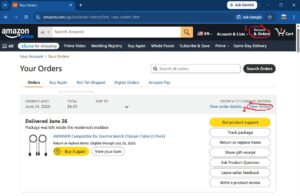
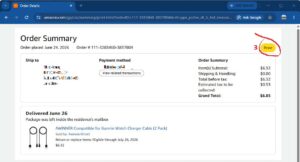
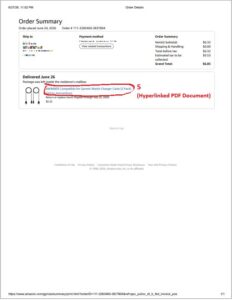
Example of proper Amazon receipt submission in 5 steps:
Step 1 & 2: View your order history and select View Invoices (Note Amazon business accounts do not allow for hyper linked printing invoice and this type of invoice submission is not acceptable. Make sure in step 5 you are able to have a hyperlink PDF document to submit)
Step 3: Click on Print when in view invoice screen
Step 4: Save as a PDF
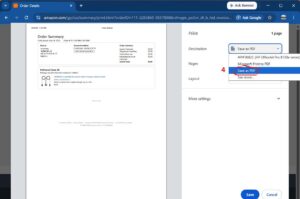
Step 5: Verify the Amazon Order Summary PDF contains working product hyperlinks before submitting it to CFEF. PDFs without functional hyperlinks may be rejected.
Product – Approved Curriculum Providers
CFEF’s approval of a product curriculum provider is intended to reduce administrative review liability, improve consistency in scholarship administration, and provide families with access to trusted curriculum. Parents remain responsible for ensuring that purchases are made for the benefit of the scholarship student and comply with all program requirements.
Approved Curriculum Providers are not subject to the administrative expenditure limit of up to 20% of the student’s total scholarship award. These types of service provider types are intended primarily for the purchase of curriculum, instructional materials, educational publications, and other curriculum-related resources. Approval of a provider under this category is not intended to create an alternative purchasing channel for products that are otherwise administered through the “Product Provider – Centralized to Amazon”.
Parents are responsible for ensuring that products purchased from Approved Curriculum Providers are consistent with the intended purpose of the Curriculum expense category. Products that are properly classified as Supplies, Equipment, Visual Aids, Educational Materials and Resources, Assistive Products, Educational Tools, Technology Products, Manipulatives, or similar product categories must be purchased through the centralized Product Provider – Centralized to Amazon process, regardless of whether the same products are also offered for sale by an Approved Curriculum Provider.
CFEF reserves the right to deny funding requests for products purchased through an Approved Curriculum Provider when CFEF determines that the product would more appropriately fall within buying from the “Product Provider – Centralized to Amazon” or otherwise conflicts with established program requirements.
To preserve consistency, auditability, and uniform administration of scholarship funds, CFEF further reserves the right to restrict, suspend, remove, or reclassify Approved Curriculum Providers if purchasing activity demonstrates repeated misuse, circumvention of purchasing controls, or patterns of purchasing inconsistent with the intended purpose of this provider type category.
No percentage cap rule is applied to the Curriculum service provider types.
- Exclusive Expense Categories: Books/Curriculum
Product – Subscriptions Tangibles
Online or Non Online Type Subscription: Primarily providing access to a tangible or digital product; minimal human service component. Subject to a 20% product cap rule and this type of category is viewed as a product type.
Examples: Monthly educational kits that are tangible products
- Exclusive Expense Categories: Subscription Tangible
Product – Subscription Services / Musical Instrument Rentals
Online or non-online subscription services and rentals that primarily provide ongoing access to services, expertise, labor, support, or educational resources are classified as “Product – Subscription Services / Rentals” and are subject to the 20% Product Purchase expenditure limit and any applicable cumulative annual or single-item dollar limits established by CFEF.
Examples: Software subscriptions with no family plans. Needs to be individualized subscription per scholarship.
Note that Musical instrument rentals and similar educational equipment rentals are classified under this category and are limited to a single maximum of $250 and the 20% Product Purchase expenditure limit.
- Exclusive Expense Categories: Subscription / Rentals
Public Government Programs – Extracurricular
Extra curricular activities occurring with District, City, County or State, Recreation Centers, Public Universities, etc..(examples). Subject to a 20% Extra Curricular Cap. All activities under this service provider type are viewed as extra curricular activities.
Note: Season tickets, Annual passes, or Subscriptions to Entertainment Venues are not allowed. This provision excludes purchases that provide ongoing access to entertainment venues, including season tickets, annual passes, and subscriptions. It does not apply to enrollment in a specific educational class, course, daily admission, or program that otherwise qualifies as an eligible scholarship expense.
Examples: Dance, Swimming, Camps, Sports Activities, Rec Center Lessons, Thanksgiving Point, Zoo, Museums, Theater, Arts. etc…
- Exclusive Expense Categories: Educational Field Trip/Experience, Extra Curricular Activity, Physical Education, Summer Education Program
Private Recreational Venues – Extracurricular
Extra curricular activities occurring with Museums, Aquariums, Art Galleries, Gyms, Sports Leagues, Private Universities, etc..(examples). Subject to a 20% Extra Curricular Cap. All activities under this service provider type are viewed as extra curricular activities.
Note: Season tickets, Annual passes, or Subscriptions to Entertainment Venues are not allowed. This provision excludes purchases that provide ongoing access to entertainment venues, including season tickets, annual passes, and subscriptions. It does not apply to enrollment in a specific educational class, course, daily admission, or program that otherwise qualifies as an eligible scholarship expense.
Examples: Dance, Camps, Sports Activities, Rec Center Lessons, Thanksgiving Point, Zoo, Museums, Theater, Arts, Cooking, Financial Literacy, Sewing, Consumer Education, etc…
- Exclusive Expense Categories: Educational Field Trip/Experience, Extra Curricular Activity, Physical Education, Summer Education Program
Statute for all Extracurricular:
- Statutory Authority: Utah Code 53E-7-401(13)(a)(xiii)(A) authorizes scholarship funds to be used for extracurricular activities, field trips, educational supplements, physical education experiences, and other educational experiences, subject to a cumulative expenditure limit of 20% of the student’s total scholarship amount. Utah Code 53E-7-401(13)(a)(iv) additionally authorizes fees for after-school and summer education programs, and Utah Code 53E-7-401(13)(a)(xi) authorizes approved LEA services, including extracurricular participation fees. (Both Public Government Programs & Private Recreational Venues are Extracurricular activities and subject to a 20% cumulative expenditure limit cap)
Extracurricular Service providers need to apply to CFEF either through an Link online application or parents can fill out a one page application form and the form signed by an official overseeing the extra curricular activity and that can represent the organization.
Additionally, for your convenience, CFEF has provided a high-level AI-narrated video overview of the Fund Use Guide. This video is intended to help families understand the guide and includes an overview of the Extracurricular Activities section. Link
Note that statute requires a federal ID on the application for the organization representing the extra curricular activity.
The following arts-related purchases are not eligible restated from the product pages:
- Musical instrument components, including tuners, straps, keys, and accessories: See Product Expense Categories. This item is restated here to clarify its classification when used in connection with extracurricular activities
- Costumes and costume-related clothing or footwear: See Product Expense Categories. This item is restated here to clarify its classification when used in connection with extracurricular activities
- General crafting, scrapbooking, or recreational craft supplies: See Product Expense Categories. This item is restated here to clarify its classification when used in connection with extracurricular activities
- Button Makers: See Product Expense Categories. This item is restated here to clarify its classification when used in connection with extracurricular activities
- Party favors, holiday supply packs, stocking stuffers, basket fillers, prize packs, and similar multipack items: See Product Expense Categories. This item is restated here to clarify its classification when used in connection with extracurricular activities
The following Camps, Programs, Memberships, activities and related expenses are not eligible:
- Normal daycare, before-school care, or after-school care
- Recreational programs without educational content or lack a documented educational purpose
- Amusement parks, theme parks, fairs, and similar attractions
- Family memberships to museums, aquariums, zoos, or educational venues
- Season tickets, annual passes, or entertainment subscriptions
- Movie, theater, or entertainment tickets or passes
- Tickets to professional theatrical productions
- Tickets to professional, collegiate, or other sporting events
- Costs associated with pageants or performances
- Competition entry fees not associated with a course or instructional program
- Early college or university enrollment expenses
- Religious camps or experiences
The following Agriculture, Gardening, and Animal buying or care activities and related expenses are not eligible:
- Gardening equipment and supplies
- Greenhouses.
- Plants, seeds, soil, fertilizer, sand, and related gardening materials
- Large or family-sized hydroponic systems
- Purchase, maintenance, housing, or care of live animals or insects
- Beekeeping equipment and supplies, including beehives, hive boxes, nucleus (nuc) boxes, flowhive, honey supers, frames, extractors, protective clothing, and related beekeeping materials, are not eligible expenses
- Chicken coops, bedding, animal processing equipment, and general animal care products
- Live animals purchased for experimentation or dissection
Subject Matter Tutors – Tutoring Services
Providing direct instruction on specific education subjects outside of the classroom and is registered in the state with a business licence and has a federal ID issued tax number. Social security numbers are not allowed for tutor service providers. No scholarship spend restrictions.
A subject matter tutor provides direct instruction to a student in a specific academic subject outside of a traditional classroom setting.
Examples may include tutoring in:
- Reading and literacy
- Math
- Science
- Writing
- History
- Foreign languages
- Other academic subjects
Tutors should have education, training, experience, credentials, or demonstrated expertise in the subject area they are teaching.
To participate in the scholarship program, tutors must:
- Have a Federal Employer Identification Number (EIN).
Social Security Numbers (SSNs) cannot be used in place of an EIN for approved tutor providers.
There is no specific scholarship spending cap for tutoring services; however, all tutoring services must meet program requirements and directly support the educational needs of the scholarship student.
- Exclusive Expense Categories: Tutoring Services
Private Schools
Only schools approved by the Utah State Board of Education (USBE) may participate as private schools in the Carson Smith Opportunity Scholarship program.
CFEF does not approve private schools. USBE determines whether a school qualifies as a private school, and CFEF uses those requirements when reviewing student enrollment.
What Is a Full-Time Private School Student?
For scholarship purposes, a student is generally considered a private school student when:
- The school is approved by USBE for the Carson Smith Opportunity Scholarship program;
- The student attends the school as their primary educational program;
The student attends in person at least: 3 days per week, and 4 hours per day for grades 1–12 or 2 hours per day for kindergarten; and the school charges tuition for a full educational program rather than individual classes.
A program must meet both the minimum attendance days and minimum instructional hours to qualify as a private school program.
Examples:
Private School Program
✔ Student attends 3 days per week for 4 hours per day
✔ Student attends 4 days per week for 5 hours per day
Not a Private School Program
✘ Student attends 4 days per week but only 3 hours per day
✘ Student attends 2 days per week, even if they attend 8 hours per day
Programs that do not meet the minimum attendance requirements may still qualify as educational programs or service providers, but they are not considered full-time private school programs for scholarship purposes.
If you are unsure whether a school or program qualifies as a private school or a service provider, please contact CFEF before enrolling or submitting expenses.
Note that Private Schools control the expense categories not parents where the private school is responsible for submitting to CFEF expense payment requests.
- Exclusive Expense Categories (Privates School Access Only): Private Edu – After School Program, Private Edu – Application Fee, Private Edu – Registration, Fee, Private Edu – Technology Fee, Private Edu – Textbook Fee, Private Edu – Tuition Fee, Private Edu – Uniform Fee
Additional scholarship funds awarded for Private School students must first be applied to eligible Private School tuition and fees. Scholarship funds must be prioritized to satisfy Private School obligations before any remaining funds may be used for other eligible scholarship expenses in accordance with CFEF policies and program requirements.
Education Instruction Alternative – (Homeschool Co-op, Microschool, Online Courses, Trade, Other)
If your student is not enrolled in a qualifying private school, they are considered a homeschooled student for scholarship purposes. Many homeschooled students participate in structured educational programs outside the home. These may include:
- Part time, Homeschool co-ops
- Part time, Microschools
- Supplemental, Online classes and programs
- Reading and math programs if not provided as a Tutoring Services then the service provider is a tutor
- Trade or vocational programs
- Test preparation courses
- Other educational programs that provide instruction to students
Unlike extracurricular activities and approved product purchases, these educational programs are not subject to the 20% spending limit.
Depending on the program, eligible expenses may include:
- Part time or supplemental Tuition and fees
- Online classes and educational programs
- Reading and math instruction if not provided as a Tutoring Services then the service provider is a tutor
- Examination and testing fees
- Industry certification exams
- College admission exam preparation courses
- Other approved educational instruction
Provider Approval Required
- Exclusive Expense Categories: Edu Alt – Online Class/Program, Edu Alt – Tuition/Fees, Edu Alt – Examination Fees, Edu Alt – Other/Undefined
Before scholarship funds can be used, the educational program or provider must be approved by CFEF.
Approved providers must:
- Have a Federal Employer Identification Number (EIN); and
- Complete any required provider applications and documentation.
Provider applications are available through CFEF and may be completed online or by paper application.
Educational Programs vs. Subscriptions Product Types (Tangible or Services / Musical Instrument Rentals)
- Some educational software, apps, and online learning tools may be considered educational subscriptions rather than educational programs.
- Educational subscriptions are generally subject to the 20% Educational Supplements and Subscription limit. However, if the provider offers a structured educational program with instruction and has been approved by CFEF as an Educational Program provider, the expense may qualify under this category and would not be subject to the 20% limit and is solely determined by CFEF.
If you are unsure how a program will be categorized, please contact CFEF before making a purchase.
Examples
Educational Programs (No 20% Limit)
- Online school or structured online course
- Homeschool co-op tuition
- Microschool tuition
- Reading intervention program
- Trade or vocational instruction
- SAT, ACT, AP, or industry certification exam preparation course
Educational Subscriptions (20% Limit May Apply)
- Educational apps
- Learning software
- Digital subscriptions without direct instruction
If you have questions about whether a provider qualifies as an Educational Program, please contact CFEF before enrolling.
Transportation – Travel Assistance
Service providing transportation service that has a Federal ID providing travel assistance is capped at $750 annually
- Exclusive Expense Categories: Transportation
The following transportation and travel expenses are not eligible:
- Lodging, airfare, meals, mileage, fuel, or transportation costs.
- Vacation or vacation-related expenses.
- Unstructured family trips.
- Associated travel costs for camps, programs, competitions, sports, or educational activities.
- Campsite fees.
- Personal auto fuel or mileage reimbursement.
- UTA monthly passes.
- Reloadable transit cards or tokens.
- Flat-rate or general-use transportation passes that do not provide individual ride details.
Public and charter schools offered courses or classes
- A scholarship student may not be enrolled in a public or charter school, but may participate in contracted services provided by a public or charter school, whether individual in-person or online classes, after-school tutoring services, transportation, or fees or costs associated with participation in extracurricular activities as long as enrollment in public or charter school is not required and the entity provides appropriate receipts or invoices
- A scholarship student may not be enrolled in a public or charter school to participate in concurrent enrollment classes. A scholarship student may be enrolled in an institution of higher learning concurrently and receive credit for these classes, and use scholarship funds to cover any related costs or be reimbursed for concurrent college level courses. A scholarship student who is enrolled in a qualified private high school may also participate in concurrent enrollment classes, and if associated fees are not covered by the private school tuition or fees, and the student has a balance of funds available, may use scholarship funds to cover these costs. Verification of concurrent enrollment is required for all reimbursement of concurrent enrollment fees
Technical College – Trade (Vocational, Technical, and Industrial)
CFEF ensures compliance with USBE requirements.
- Exclusive Expense Categories: Trade
The following vocational and technical purchases are not eligible:
- Licensing fees (e.g., pilot, cosmetology, trade licenses).
- Professional-grade or industrial-grade tools.
- Large industrial tools.
- Power tools.
- Laser cutting accessories.
- Wood-burning tools.
- Forges and related equipment.
- Welding machines.
- Heavy equipment or machinery.
- Farm and shop equipment.
- Farm tools (gas or electric).
- Automotive tools, supplies, batteries, or accessories.
- Related tools, equipment, and supplies associated with unapproved Vo/Tech coursework.
General Prohibited Use of Scholarship Funds if not stated in the guidelines already.
Scholarship funds may not be used for:
- General entertainment not directly tied to educational goals.
- Travel, lodging, meals, or vacation expenses.
- Commercial, resale, gifting, or mass-production activities. (i.e. Kids or Farmer’s markets)
- Purchases primarily intended for family use rather than the scholarship student.
- Services or products provided by unapproved vendors or service providers.
- Recreational robotics, toy robotics, or similar entertainment-focused devices.
- Personal aides for the scholarship student.
- Fantasy games.
- Parents may not split receipts or designate portions of a single receipt to multiple scholarship students. Each receipt must correspond to a single scholarship participant and clearly reflect only the eligible expenses for that student’s scholarship. Parents with multiple scholarship participants must complete separate purchases and obtain separate receipts for each scholarship student. CFEF will not allocate or apportion shared receipts among multiple scholarship participants.
- Parents must submit only one receipt with each scholarship fund use request. Multiple receipts may not be combined into a single request. Each fund use request must correspond to a single receipt, and each receipt must be submitted as a separate scholarship fund use request.
- Parents must not include personal purchases on the same receipt as scholarship purchases. Doing so will result in an automatic denial.
- Parents may combine multiple pages that relate to the same transaction into a single receipt file for submission with a scholarship fund use request. All other scholarship fund use request requirements continue to apply, including reimbursement requests, which must include both an invoice and acceptable proof of payment. Because cash payments are difficult to verify during audits, CFEF strongly encourages parents to pay by credit card, debit card, electronic payment, or check whenever possible. If a reimbursement request is paid in cash and is selected for audit or additional review, the parent and/or service provider may be required to provide documentation demonstrating that the cash payment was received and deposited, or other satisfactory evidence of payment acceptable to CFEF.
Continuing Administrative Interpretation
This Scholarship Fund Use Guide replaces prior editions. However, administrative procedures, documentation standards, operational requirements, and interpretive guidance published in prior editions that are consistent with this guide and not expressly modified or superseded by this edition remain in effect until revised or withdrawn by CFEF. Where a conflict exists between this guide and a prior edition, this guide controls.
This Scholarship Fund Use Guide is subject to revision throughout the scholarship year. Parents are responsible for referring to the most recent version by reviewing the document’s revision date. CFEF will notify scholarship recipients by email whenever substantive changes to this guide are made.
Updated 07/16/2026
Appendix A – Continuing Administrative Policies and Procedures if not already addressed in the guide
The following administrative procedures remain in effect and supplement this Scholarship Fund Use Guide. Unless expressly modified within this guide, these administrative procedures continue to apply to all scholarship fund use requests, reimbursements, scholarship debit requests, and other scholarship transactions.
Monthly Funding Request / Reimbursement Schedule
- Monthly Submission Deadline: Funding requests must be submitted no later than 10:00 p.m. (Mountain Time) on the last calendar day of each month to be included in the following month’s processing cycle.
- Late Submissions: Funding requests submitted after 10:00 p.m. (Mountain Time) on the last calendar day of the month will be processed during the next monthly processing cycle and will not be included in the immediately following month’s processing.
- Monthly Processing Schedule: CFEF aims to review and process all funding requests received by the monthly submission deadline on or before the 15th of the following month. Processing timeframes are estimates and may vary based on submission volume, request complexity, or the need for additional documentation.
- Expected Reimbursement Schedule: For approved reimbursement requests, CFEF aims to initiate ACH reimbursement payments on or around the 25th of each month for requests submitted by the previous month’s submission deadline. Payment dates are estimates and may vary due to banking schedules, holidays, or other administrative factors.
Direct Payment Services and Scholarship Fund Requests
- Any CFEF-approved platform feature that allows scholarship funds to be paid directly to an approved service provider, or otherwise allows the use of scholarship funds without submitting a reimbursement request, will follow a similar review, approval, and fund disbursement process established by CFEF. Before any such feature is made available to parents, CFEF will conduct comprehensive testing and validation to ensure the feature operates as intended and maintains appropriate financial, administrative, and audit controls. CFEF will not release new payment or fund use features until they have been thoroughly tested and determined to support the integrity of the Carson Smith Opportunity Scholarship Program and safeguard the proper administration of scholarship funds. CFEF continues to work with its platform partners and software developers to expand the payment options and scholarship fund use features available to parents. New features will be rolled out as they become available only after they have been thoroughly tested and validated by CFEF to ensure they meet program requirements and maintain the internal controls necessary for the proper administration and oversight of scholarship funds.
Partial Funding Requests
- Scholarship fund use requests may only be approved if the student’s scholarship account contains sufficient available funds. CFEF does not split funding requests across scholarship years or funding periods, and scholarship funds may not be combined, transferred, or split among multiple scholarship recipients, including siblings.
- Partial reimbursement/funding requests are not permitted unless expressly authorized by CFEF.
- Items exceeding applicable expenditure limits may be denied in full.
Detailed Receipt Requirements
- Transaction date
- Vendor name
- Itemized products/services
- Total paid
- Taxes
- Payment Method (Cannot be a gift card or cash as the payment method)
- Proof of Payment (Check with check number, Credit Card)
- Student’s name for services
- Handwritten receipts not allowed
- Altered invoices not allowed
- Bank or Credit Card statements are not an acceptable form of “Proof of Payment” and not allowed
Because CFEF has centralized product purchases through the Product Provider – Centralized to Amazon model, the detailed lists of prohibited products from prior years policy guides are no longer necessary for determining product eligibility. They are provided below for reference only to help families understand examples of items that were previously identified as ineligible.
- Garage Sales items
- Facebook Marketplace
- Craigslist
- Classified ads
- Goodwill
- Deseret Industries
- Savers
School Transfers: Scholarship funding adjustments resulting from transfers between qualifying schools, changes in homeschool status, or other enrollment changes are determined solely by CFEF in accordance with applicable law, scholarship availability, administrative requirements, and program circumstances. Parents should not assume that scholarship funds will be transferred or prorated in any particular manner. When a proration is required, CFEF will calculate the adjustment on a monthly basis and notify parents of the resulting scholarship amount.
Refund Procedures
- Refunds belong to scholarship
- Provider returns funds to CFEF
- Parents may not retain scholarship refunds
- CFEF adjusts scholarship balance
Parent Financial Responsibility: Parents remain financially responsible for services they choose to purchase until scholarship funds are approved and disbursed by CFEF. Approval of scholarship funding requests is contingent upon compliance with this guide and availability of scholarship funds. CFEF is not financially responsible for obligations parents voluntarily incur.
Appendix B – Historical changes to guide
Change Date: 7/7/2026
- Page 7-8 relating to the Quick Reference Guide to help show the page numbers in the guide to reference type and category details.
- Page 19 word change “intended to reduce administrative review burden” to “intended to reduce administrative review liability”
- Page 20 word change “Musical instruments and instrument components” to “Musical instrument components”
Change Date: 7/14/2026
- Page 7 and 10 added “Vision Therapy / Eye Therapy provided by a licensed optometrist or ophthalmologist when documented as supporting the student’s educational needs” as an approved therapy type.
- Added “CFEF Scholarship Fund Use Guide” on the header of each page in the guide
Change Date: 7/16/2026
- Page 20 adjustments as follows to become in compliance with Utah Code § 53E-7-401(13)(b) – Definitions – “Scholarship expense” ○ Deleted: “The following family memberships, subscriptions, passes, and related expenses are eligible only when purchased as an individual membership, subscription, or pass for the scholarship student. Family, household, group, or multi-person memberships, subscriptions, or passes that cannot be allocated on a one-to-one basis to the scholarship student are not eligible. Eligible purchases must represent a direct one-to-one association between the scholarship student and the membership, subscription, or pass. For extracurricular activities provided by an approved service provider, only the provider’s basic individual membership or pass is eligible. If the service provider does not offer an individual membership or pass and instead requires a family, household, group, or multi-user membership or pass for participation, the parent must obtain written pre-approval from CFEF before making the purchase which will then be divided to a one to one ratio. Note Punch and Loyalty reward passes ext.. are not allowed”
- Added: “Note: Season tickets, Annual passes, or Subscriptions to Entertainment Venues are not allowed. This provision excludes purchases that provide ongoing access to entertainment venues, including season tickets, annual passes, and subscriptions. It does not apply to enrollment in a specific educational class, course, daily admission, or program that otherwise qualifies as an eligible scholarship expense.”
- Page 2 change wording: “If you are unsure whether an expense is eligible, we encourage you to contact CFEF before making a purchase and valid” to “If you are unsure whether an expense is eligible, we encourage you to contact CFEF before making the purchase”
- Page 10 bullet point correction: “Behavioral TherapySpeech-Language Therapy” to separate “Behavioral Therapy” and “Speech-Language Therapy”
- Page 13 under Sports Equipment bullet added missing quotation marks in front of Equipment to read as “Equipment”
- Page 19 added wording: “Monthly educational kits that tangible products” to “Monthly educational kits that are tangible products”
- Page 20 changed wording so it’s not randomly inserted in the section: “A high-level AI-Narrated video guide overview Link” to “Additionally, for your convenience, CFEF has provided a high-level AI-narrated video overview of the Fund Use Guide. This video is intended to help families understand the guide and includes an overview of the Extracurricular Activities section.”
- Page 24: converted the text into bullet points under the Educational Programs vs. Subscription Product Types (Tangible or Services/Musical Instrument Rentals) section.
- Page 28 changed wording to second to last bullet point from: “Parents are not add personal purchases on receipt which will result in an automatic denial” to “Parents must not include personal purchases on the same receipt as scholarship purchases. Doing so will result in an automatic denial.”